


Title here
Summary here
Facing key advertising challenges? Take control of your tracking: audit, optimization, GDPR compliance, CMP, Consent Mode v2, and server-side tagging.
Contact Lucas or book a discovery callGoogle Tag Manager
Questions about this article?
Open it in your AI assistant to summarise it or apply it to your setup.
When you display your phone number on your website, your leads can copy the phone number to call you without necessarily interacting with your website.
In that case, Google Ads call tracking becomes more complex, because some of the phone calls generated by your ads can happen outside of any measurable interaction on the website.
It is therefore difficult to track call conversions because the only action that can be tracked is the click on the number. The problem is that clicking on the number doesn’t necessarily lead to a call and can feed Google’s machine learning algorithms with data that doesn’t reflect reality.
In other words, tracking only the click on a phone number doesn’t tell you precisely which Google Ads calls actually happened. This can skew your conversion data, your campaign performance analysis and, ultimately, your bidding strategies.
The solution is to change the phone number displayed on your website. The new number will point to a Google server which will then redirect the call to your own phone number.
Google then uses a forwarding number to track Google Ads calls. This Google forwarding number temporarily replaces your usual number for visitors coming from your Google Ads ads, while redirecting calls to your real phone line.
The new number will be a 0 805... number (in France). It may reduce your visitors’ trust because it isn’t a number they’re used to. It’s a trade-off between tracking accuracy and visitor trust.
On the other hand, this call tracking mechanism gives you much more reliable information about the calls generated by your campaigns: whether the call actually took place, how long it lasted and where the conversion came from, among other things.
This way, Google acts as an intermediary and can track actual calls made from your website.
Start by creating this type of conversion action in Google Ads. This conversion action lets Google Ads identify phone calls made from your website and attribute them more precisely to your campaigns and ads.

In Google Ads, select “Phone calls” tracking, then choose the option for calls to a phone number on your website. This is the type of conversion that will then let you set up the Google forwarding number.
Next you need to configure the Phone numbers section. Here, it is very important to write the phone number exactly as it is displayed below the field.
The number you enter must therefore exactly match the number displayed on your website page. Google will then be able to identify this number and replace it with its forwarding number to track calls.

Good to know
The destination number remains your real phone number. The number to display is the one shown on your website, which Google will temporarily replace when a visitor coming from a Google Ads ad views the page.
You can also specify the length of time after which the conversion will be counted. If you don’t know what to put here, you can leave it at 60 seconds.
This duration prevents some very short or accidental calls from being counted as conversions. For example, with a minimum duration of 60 seconds, only calls that reach this length will be recorded as conversions in Google Ads.

The right threshold obviously depends on your business and your sales process. A company that qualifies its leads in a few seconds won’t necessarily need the same duration as a service that requires a longer phone conversation!
Once the conversion has been created, note the Conversion ID and Conversion Label displayed. You’ll need both to connect the Google Ads conversion action to Google Tag Manager and continue setting up your tracking.

We’re now going to install the Google Ads Calls from Website Conversion tag. This tag links your website, Google Tag Manager and the conversion action created in Google Ads to track calls.

This tag will replace the number(s) on your website with a number that redirects to a Google server.
In practice, Google displays a forwarding number instead of your usual phone number for some visitors coming from your ads. Calls are then redirected to your real number, which lets Google Ads measure phone conversions more accurately.
To do this, you need to tell the tag the number to replace, exactly as it appears on your website. You must therefore use the same format as the one displayed on the page, including spaces and how the number is laid out. If Google doesn’t recognize the number on the website, replacing it with the Google forwarding number may not work properly.
Remember to also enter the Conversion ID and the Conversion Label that we saw earlier in Google Ads.
This information lets you link the Google Tag Manager tag to the right conversion action in your Google Ads account.

The tag must fire on the pages where the phone number appears. If the same number is shown across the whole website, firing on all pages can make sense. Conversely, if it’s only displayed on certain pages, you can limit the trigger to those pages.
You must also configure the Conversion Linker tag on all pages.
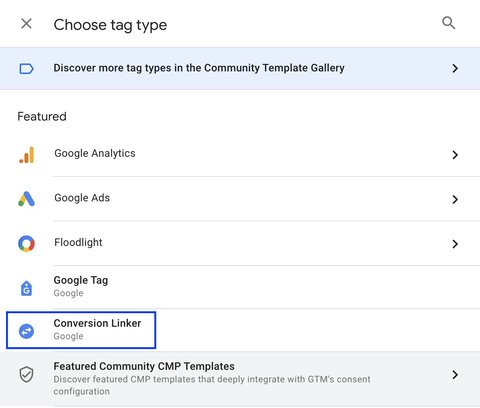
This tag helps preserve the information related to the click on your Google Ads ads, so that conversions can then be better attributed to your campaigns.
Good to know
If a Conversion Linker tag is already present and correctly configured in your Google Tag Manager container, there’s no need to create a second one!
To test that the call conversion tag is working correctly, you need to add the #google-wcc-debug fragment to the end of your URL. WCC stands for Website Call Conversion.
This method lets you check that Google can identify and replace the phone number configured in your tag before testing call tracking in real conditions.
Here, I’m going to test with Google Tag Manager’s debug mode:

Then you’ll see this at the bottom left of your website:

By clicking on the Force button, all the numbers on your website that match the number you configured in the tag will be replaced by 9999999999.
This replacement lets you quickly check that the tag recognizes the number on the page and that your tracking configuration is correct.
If this is the case, it means that your configuration is working correctly. In reality, your numbers will not be replaced by 9s but by the Google server number, and only for visitors coming from one of your Google Ads ads.
The google-wcc-debug test therefore mainly checks the number replacement mechanism. It doesn’t yet confirm that a real call will be correctly attributed to a campaign or counted as a conversion in Google Ads.
To test this in real conditions, first publish your container in Google Tag Manager, then find one of your ads on Google Ads and click on it.
You can then check that the Google forwarding number is displayed on your website and make a test call to verify that the conversion and its associated data are reported in Google Ads.
Google Ads call tracking goes further than a simple click on a phone number. Once tracking is correctly configured, you can collect several useful pieces of information to analyze your campaign performance and the quality of the calls generated.
Depending on your setup, you can track:
This data helps you understand which campaigns actually generate leads by phone, not just clicks on your website. You can then use this information to adjust your bids, your ads and your Google Ads strategy based on the calls that bring the most value to your business.
Good to know
Not all calls have the same business value. If your sales cycle relies heavily on the phone, remember to adapt the minimum conversion duration to the reality of your conversations with your leads.
Google Ads call tracking significantly improves tracking accuracy, but it can’t measure every phone call without limits!
The first constraint comes from the Google forwarding number. The number displayed may differ from your usual number, which can sometimes cause confusion or reduce some visitors’ trust. You need to find the right balance between tracking accuracy and user experience.
Tracking also depends on the phone number being correctly replaced on your website. If the number in the Google Tag Manager tag doesn’t exactly match the one displayed on the page, or if the tag doesn’t fire correctly, call tracking may not work.
Another important point: this solution is primarily designed to attribute calls generated by your Google Ads ads. It doesn’t necessarily replace a complete call tracking solution if you want to track and compare calls from several marketing sources, such as SEO, social media, email or other advertising campaigns.
Finally, data quality depends on how you define a conversion. A 10-second call probably doesn’t have the same value as a conversation of several minutes with a qualified lead. Setting the minimum call duration is therefore essential to avoid sending Google Ads signals that don’t truly reflect your performance.
tel: links still work correctly once the number has been replaced.A question about this article, need an audit of your setup or server-side migration? Drop me a line, I reply within 24h.
Prefer to talk it through? Book a discovery call →

Guide to install the ChatGPT Ads Measurement Pixel with GTM using my OpenAI Ads Measurement Pixel by DMS tag: GA4 events, hashed user data, …

Install Microsoft Clarity with Google Tag Manager in 10 minutes: official tag, Consent V2 (Axeptio, Didomi) and Smart Events.
Track Calendly meetings and retrieve your invitee's data (email, phone, UTM, payment, form answers) with my sGTM variable

Comments
Join the discussion
A question, some feedback, a specific case? Leave a comment: I reply to every one.